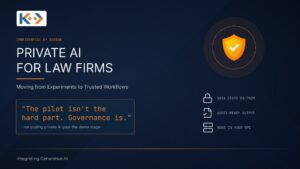
Private AI for Law Firms:
Moving from Experiments to Trusted Workflows
Adoption has moved from curiosity to commitment. That shift depends less on a smarter model and more on privacy, governance, and human judgment working together.
Actively integrating
Legal organizations actively integrating generative AI in 2025, up from 14% in 2024
Central within a year
Firms that use generative AI or plan to make it central to their workflow
Citation errors
AI errors or fabricated citations recorded in court filings in 2025 — more than 10× the prior year
Blocked on trust
Named confidentiality, quality and privacy the top roadblock to firm-wide adoption
The Shift
The experiment phase of legal AI is almost over
Adoption has moved from curiosity to commitment, and the numbers make that clear. Thomson Reuters found that the share of legal organizations actively integrating generative AI nearly doubled from 14 percent in 2024 to 26 percent in 2025, and that 45 percent of firms either use it or plan to make it central to their workflow within a year. In corporate legal departments, generative AI use has more than doubled, with over half of in-house counsel now using it for drafting and research.
Legal organizations actively integrating generative AI
Share of legal organizations, 2024 → 2025
The Real Barrier
Why trust, not capability, is the real barrier
The gap holding firms back is not model quality. It is confidence. In one survey, confidentiality, quality, and privacy were the top roadblock to firm-wide adoption for half of respondents, with data security, ethics, and privilege close behind.
The risk is not hypothetical. Courts recorded 487 instances of AI errors or fabricated citations in filings during 2025, more than ten times the prior year, and licensed attorneys were responsible for a large share of them. At the same time, many organizations concede that AI poses at least moderate risk while fewer than half have basic safeguards in place, and most solo and small firms still operate without any AI policy at all.
We read those numbers not as a reason to slow down, but as a map of what to fix. The firms pulling ahead are the ones treating trust as a design requirement rather than an afterthought.
Definition
What private AI means
Private AI is a simple idea with serious implications. It means running AI inside an environment the firm controls, grounded in the firm's own governed content, without exposing client data to public models or using it to train systems the firm does not own. In practice that means data stays within the firm's secure tenant, access follows existing permissions and ethical walls, and every answer can be traced back to a source. Public, consumer-grade tools brought speed. Private AI adds the control that legal work has always demanded.
Where the client data goes
Switch between the two approaches
The Discipline
From experiments to trusted workflows
When we advise legal teams, we treat the move from pilot to production as a discipline built on five practices. Select any step to expand it.
The Single Most Effective Defense
Grounding answers in governed matter files and precedent, so responses reflect the firm's knowledge rather than the open internet, is the single most effective defense against fabricated citations.
In Practice
A practical picture
Consider an associate preparing the first draft of a motion. With private AI grounded in the firm's precedent, the assistant retrieves the firm's own approved language, cites internal sources the associate can open and verify, and respects the confidentiality wall around a sensitive matter.
Outcome 01
The associate moves faster
The assistant retrieves the firm's own approved language.
Outcome 02
The partner trusts the output
It cites internal sources the associate can open and verify.
Outcome 03
The client's data never leaves the firm
It respects the confidentiality wall around a sensitive matter.
The same pattern serves corporate legal teams reviewing contracts against their own playbooks. Technology is impressive, but the trust comes from the guardrails around it.
The Bottom Line
Experimentation becomes trusted practice
Legal AI has proven its value. The work ahead is turning promising experiments into workflows that partners, general counsel, and clients can rely on every day. That shift depends less on a smarter model and more on privacy, governance, and human judgment working together. For law firms and corporate legal departments, private AI is how experimentation becomes trusted practice, and how the profession captures the value of AI without compromising the duties that define it.
FAQ